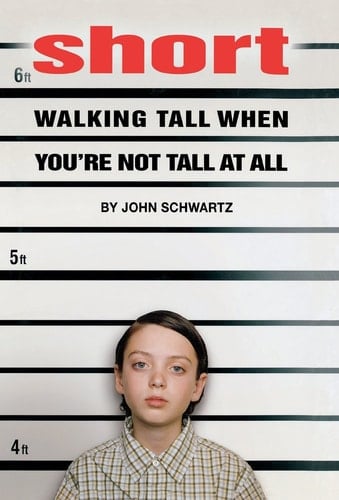
About This Book
"Short Walking Tall When You're Not Tall At All" is a compelling nonfiction chapter book by John Schwartz that tackles the complex topic of height. Aimed at children aged 4-11, it explores the societal and psychological aspects of being short, including the history of "get-tall" advertisements, the science behind human growth hormone, and even extreme medical procedures like limb lengthening. Schwartz, who is himself short, weaves in personal anecdotes while critically examining how marketing preys on insecurities. The book encourages self-acceptance and critical thinking about societal pressures, making it an excellent resource for parents looking to discuss body image, self-esteem, and media literacy with their children. It provides a balanced view of medical interventions versus embracing natural differences.
<p>The Fixers</p><p>When I was a kid, twelve cents could buy you a lot of fun. Thatâs what a comic book cost then. I could buy eight of them for a dollar at the Piggly Wiggly store, and read the adventures of Superman, Batman, and the Green Lantern. When I was nine, my mom even bought me a Superman suit and cape and I would actually wear them around the house. Iâd jump off the couch, the cape .ying behind me, and sometimes even wore the suit under my clothes just like Superman did. My dad tells me he was scared to death that Iâd try climbing up on the roof to see if I could really .y. I avoided that disaster, though. Even then, I knew it was make-believe. I would never be faster than a speeding bullet, but a boy could dream.</p><p>Reading my comic books, I lingered over the ads for 'elevator shoes' and Liftee height pads that promised to add between two and four inches of height 'invisibly.' How did those work? The word elevator made it sound like there was something mechanical in there, or maybe even magical. But the shoes really just had soles that were several inches thick. Even in the ads, those monster shoes looked like they might be too heavy for my little matchstick legs to lift. Iâd be taller, but Iâd have to stand in one place all day.</p><p>'BE TALLER- Stand 2â 6 inches TALLER in a few weeks. All ages. No gimmicks. GUARANTEED. Send 35¢. . . .'</p><p>The get-tall ads were right by the ones for big-muscle programs from Charles Atlas bodybuilding that would, if I sent Mr. Atlas money and followed the directions in his booklet, help me follow his path from '97-pound weakling' to 'the worldâs most perfectly developed man.' Even better: Mike Marvel, who</p><p>'CAN BUILD YOU A MAGNIFICENT NEW HE- MAN- MUSCLED BODY IN JUST TEN MINUTES A DAY-</p><p>with absolutely NO weights-</p><p>NO bar- bells-</p><p>NO EXERCISE AT ALL!'</p><p>In the years between my time as a kid and yours, a lot of things have happened. Comic books cost four dollars or more these days. And we now have spam to tell us we can get taller, or, um, bigger. But the basic idea-the idea that thereâs something terribly, tragically wrong with you, and if you just give us money we will .x it-is still the same.</p><p>The pitches have never gone away, and never will, because the marketers know that most of us believe, deep down, that in some way we donât measure up. That our bodies could be better. Should be better. And they think that we will pay dearly for the promise of a .x.</p><p>Sleazy salesmen have no trouble at all playing on that kind of insecurity and selling short guys fake drugs that they promise will make them taller. The U.S. government recently cracked down on a company selling something called Heightmax that was supposed to increase height by 35 percent in a year for users between the ages of twelve and twenty-. ve.</p><p>Letâs do that math: That would mean somebody .ve feet tall would grow an additional 21 inches- nearly two feet. The wonderful people who pulled off this scam faked an 'inventor' whose name they put in radio ads, and had testimonials from people who said their lives had been changed by the magic medicine. The ads said Heightmax would be 'the answer to your prayers.'</p><p>The company didnât admit that they were scam-ming people. Instead, they settled the governmentâs lawsuit against them, paying nearly two million dollars in .nes. But think about it: That means that even though the claims were obviously absurd, they had sold millions of dollarsâ worth of this worthless product to suckers. And that is a lesson in just how powerful the urge is to take what nature gave us and stretch it. The makers of Heightmax are not the only ones. Theyâre just the most recent ones to get caught.</p><p>Now, donât go thinking that anybody who says he can make you taller is just full of hot air and that the only transformation he is capable of is tranforming your money into his. There are legitimate treatments out there-but some of them sound more like the stuff of horror movies than medical treatment. And while the scams tend to be harmless aside from the money that the suckers lose, the treatments can lead to pain and disaster.</p><p>The most extreme example is a pro cess called limb lengthening. The details are gruesome: Doctors actually saw apart the patientâs leg bones and put the legs in adjustable braces that look a little like cages with knobs on them. (You really donât want to see the pictures.) The patient then turns the knobs a few times a day, which stretches the bone apart a tiny bit at a time. In other words, itâs like a medieval torture rack, but itâs applied in a hospital instead of a dungeon. The other difference is that the patients pay for their torture: about $25,000. If everything goes right, the healing bone bridges the gap bit by bit, and over six monthsâ time in the brace the patient can get to be a few inches taller. It takes two years to recover fully.</p><p>The procedure is especially popular in China, where the government discriminates against people based on height. There are height requirements for some professions there, so being short can keep people from getting positions as diplomats, . ight attendants, and more. A story in the New York Times said that would- be Chinese diplomats must be at least .ve foot seven if they are men, .ve foot three if they are women. The Chinese news agency says that men have to be .ve foot nine and women, . ve foot .ve to apply for college majors such as acting or broadcasting. Whatâs a short person to do? Well, some folks get lengthened. And, sadly, the Chinese press is full of accounts of surgeries gone horribly wrong. There are legitimate problems, such as dwar.sm or having one leg shorter than the other, that are severe enough to justify the risks of surgery, but the procedure is just way too dangerous and painful to go through just to look taller.</p><p>In 2006, China cracked down on the surgery. Mao Qunâan, a Health Ministry spokesman in China, said that it 'must only be carried out for strict medical reasons.'</p><p>Good luck with that one, Mao. It looks like the surgery isnât going away anytime soon. One Chinese doctor, Dr. Xia, advertises his Beijing Institute of External Fixation Technology around the world. His website says that the institute is 'where science and technology meet your dreams.'</p><p>Yikes.</p><p>In the United States, patients are more likely to turn to drugs when they want to grow taller. And there is a lot of work by real scientists and real drug companies to help people to grow. They arenât like the sleazy Internet guys-their treatments, depending on which study you read or which doctors you talk to, might end up buying you an extra inch or two. But there are some real problems with the way that they sell their stuff, too.</p><p>So letâs talk about drugs.</p><p>No, this is not a DARE lecture. I mean medicine to give people a height boost-human growth hormone. Like the leg surgery, it started as an attempt to .x medical problems. But, like the leg surgery, its use has spread to people who are merely short.</p><p>Human growth hormone is a chemical messenger that occurs naturally in the body and is part of the pro cess that spurs growth and development. If a personâs body doesnât produce enough of it, that person is likely to be very small, and the small person is said to have a medical condition such as dwar. sm.</p><p>Those people can be helped by injections of human growth hormone, which helps supply what their body doesnât.</p><p>In the early days, scientists didnât know how to manufacture the hormone, so they extracted it from the bodies of dead people. By 1985, a synthetic version had been developed and was approved for use as a medicine, mainly for those people suffering from severe problems such as dwar.sm. Some doctors prescribed it for patients who didnât have those problems, though. Bodybuilders wanted it, though it hasnât been proven to actually help them. (Those guys will take just about anything that they think will pump them up.) And some doctors also started prescribing the hormones for children who donât have a hormone de.ciency but are just plain short. Thatâs a big difference.</p><p>Before long, the drug companies were pushing the government to give its blessing to what they had been doing anyway. And so, in 2003, the government did approve the use of growth hormones for short kids who werenât suffering from a medical condition-to be speci.c, the shortest 1.2 percent of children. For ten-year-old boys and girls, that meant anyone shorter than four foot one. The idea was that it would be used in kids likely to grow to adult heights of less than .ve foot three (for boys) and four feet eleven (for girls.) Did I mention that Iâm . ve foot three? So I am of.cially really short. But I didnât need a government ruling to tell me that.</p><p>The phrase that was used by the drug companies and the government to describe being short was a whopper: idiopathic short stature. Idiopathic is one of those great words doctors and scientists use to describe something that they donât understand, something with an unknown cause. So idiopathic short stature means 'this person is short and itâs not for any of the medical conditions we know about, such as, say, growth hormone de.ciency.' Now, the most common reason that somebody is short is that his parents are short-weâll talk a little more about that later on. But using fancy words derived from Greek with a lot of syllables makes it all sound very medical, very disease-ish.</p><p>Itâs not the .rst time that the medical industry has tried to sell cosmetic treatments by using a fancy medical-sounding name for the problem-they used the same trick back in the early days of breast implants.</p><p>As you might have noticed, breasts come various sizes. Some women whose breasts are on the smaller side would like them to be bigger-and, wouldnât you know it, an industry has grown up around making money off those feelings of being too small and inadequate. The medical answer is breast implant surgery, and hundreds of thousands of women a year get the procedure done.</p><p>The companies that wanted to sell women on the idea of making their breasts bigger didnât use plain words such as . at chested. Instead, they made it sound like a medical condition that needed treatment, and called it 'micromastia.' The companies making breast implants argued that women with .at chests suffered from a lack of con. dence and would lack success in love and careers. To hear the doctors talk about it, the women were destined to have a second-class life.</p><p>Sound familiar?</p><p>And so, when the Food and Drug Administration considered giving its blessing to using growth hormone to treat the terrible disease of shortness, one of the scientists from Eli Lilly, a hormone maker, called the condition a 'growth failure problem.' The scientists laid out a list of problems that short kids face that made it sound as if it would be cruel to deprive them of the solution. And the announcement from the government that the drug had been approved for merely short kids talked a lot about idiopathic short stature. It was all very medical-sounding.</p><p>Growth hormone has been a real blockbuster in the years since the approval. According to the market research company IMS Health, the growth</p><p>Excerpted from Short by John Schwartz.</p><p>Copyright © 2010 by John Schwartz.</p><p>Published in April 2010 by Roaring Book Press.</p><p>All rights reserved. This work is protected under copyright laws and reproduction is strictly prohibited. Permission to reproduce the material in any manner or medium must be secured from the Publisher.</p>
Discussion Prompts
1
Why do you think some people want to be taller?
2
What are some ways that advertisements try to make us feel like we need to "fix" something about ourselves?
3
How can we build confidence in ourselves and others, no matter what we look like?
4
What does "walking tall" mean to you, even if you're not physically tall?
5
Do you think it's fair for jobs or schools to have height requirements? Why or why not?
External Reviews
If Your Family Enjoyed This
Reviews
No reviews yet — be the first to share how this book landed with your family.