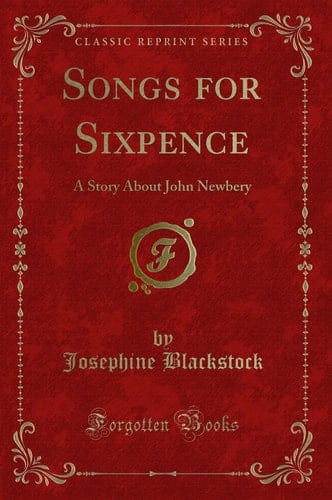
About This Book
Songs for Sixpence is a biographical narrative about John Newbery, the influential 18th-century English bookseller and publisher. Often called the 'father of children's literature,' Newbery was instrumental in creating books specifically for young readers, including the beloved Mother Goose's Melody. This middle grade book, suitable for ages 8-12, offers a glimpse into English life in the 1700s and the early days of publishing, celebrating the legacy of the man for whom the prestigious Newbery Award is named. It's an informative yet engaging read for children interested in history, books, and the origins of familiar tales.
Excerpt from Songs for Sixpence: A Story About John Newbery I have asked several hundred people - they were all ages, children, mothers, and grandmothers - what tales they remember best; and most of them said Mother Goose. We owe this name for our nursery rhymes to an eighteenth-century English bookseller - John Newbery, the first publisher to make something of a specialty of children's books. He lived back before the American Revolution, and one of his many books was among the earliest collections of nursery rhymes, and among the best. It was called Mother Goose's Melody, and it was reprinted again and again for American children, with more and more additions, long after John Newbery was dead and the American Colonies had become the United States of America. Though the Newbery Award for the most distinguished American children's book of the year is named in honor of John Newbery, not many people know much about him. I enjoyed reading about him and about his author friends and about English life in the seventeen hundreds and the first children's books. About the Publisher Forgotten Books publishes hundreds of thousands of rare and classic books. Find more at www.forgottenbooks.com This book is a reproduction of an important historical work. Forgotten Books uses state-of-the-art technology to digitally reconstruct the work, preserving the original format whilst repairing imperfections present in the aged copy. In rare cases, an imperfection in the original, such as a blemish or missing page, may be replicated in our edition. We do, however, repair the vast majority of imperfections successfully; any imperfections that remain are intentionally left to preserve the state of such historical works.
Discussion Prompts
1
Why do you think John Newbery felt it was important to create books specifically for children?
2
What was life like in England during the 1700s, based on what you read about John Newbery's time?
3
How do you think children's books have changed since John Newbery's time? What's different, and what's still the same?
4
If you could ask John Newbery one question, what would it be and why?
5
What does it mean to be a 'pioneer' in a field, and how does John Newbery fit that description?
External Reviews
If Your Family Enjoyed This
Reviews
No reviews yet — be the first to share how this book landed with your family.