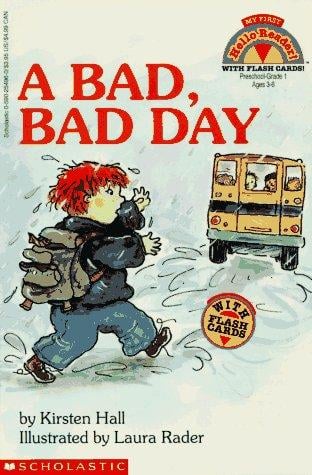
About This Book
A young boy's day starts badly, but his mood improves when his teacher gives him a good mark on his paper.
Wonderlit Review
A young boy wakes up feeling grumpy and experiences several minor setbacks, leading to a truly "bad, bad day." His mood is visibly low until he receives a positive affirmation from his teacher in the form of a good mark on his schoolwork. This small success completely turns his day around, illustrating the power of positive reinforcement and self-esteem. The book handles the topic of negative emotions, specifically frustration and sadness, in a very gentle and age-appropriate manner. It doesn't dwell on the negativity but rather presents it as a common experience that can be overcome. The resolution is secular, focusing on personal experience and a teacher's encouraging action. The book starts with a clear dip in mood, reflecting the boy's initial frustrations. The arc then steadily rises as he encounters the positive feedback, ending on a distinctly uplifting and hopeful note. It's a journey from gloom to glee. This book is perfect for children who are prone to "bad days" or who struggle with managing their initial reactions to minor setbacks. It's also great for children who might need a boost in self-confidence, especially regarding school performance or social interactions. A parent would reach for this book when their child is having a particularly grumpy or frustrating day, or when they want to open a conversation about how to cope with negative emotions. It's also useful for discussing the impact of small acts of kindness or achievements. No specific scenes require previewing. Parents might want to pre-read to familiarize themselves with the rhyming structure and be ready to discuss the boy's feelings and the teacher's role. Younger children (4-6) will relate to the simple cause-and-effect of a bad mood and the immediate relief of a positive outcome. Older children (7-8) might appreciate the nuance of how small things can accumulate to create a feeling, and how a single positive event can shift perspective. The rhyming makes it engaging for all. While many books address bad moods, "A Bad, Bad Day" stands out by explicitly showing how a specific, positive external validation (the good mark) can be the turning point, rather than solely relying on internal coping mechanisms. The rhyming format also adds to its appeal for read-alouds.
If Your Family Enjoyed This

Reviews
No reviews yet. Be the first to share how this book landed with your family.