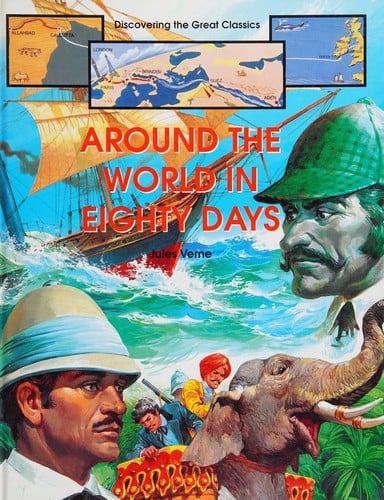
Jules Verne's 'Around the World in 80 Days' is a quintessential adventure narrative, following the impeccably precise Phileas Fogg and his new, excitable valet, Passepartout, as they embark on an audacious wager to circumnavigate the globe in just 80 days. Their journey is a whirlwind of steamships, trains, and even an elephant, taking them across continents and through diverse cultures. The plot is propelled by a relentless ticking clock and the constant interference of Detective Fix, who mistakenly believes Fogg is a bank robber and attempts to delay his progress at every turn. Along the way, they rescue Aouda, an Indian princess, who joins their party, adding a layer of found family to the high-stakes travel.
The book handles sensitive topics, such as the rescue of Aouda from a funeral pyre, with a sense of adventure and heroism, rather than dwelling on the grim details. The emotional arc is one of constant challenge and unwavering determination, culminating in a triumphant, albeit surprising, resolution. It starts with a seemingly impossible goal and maintains a fast pace, ending with a satisfying blend of victory and romance.
This book is specifically for children who love grand adventures, historical settings, and stories of ingenuity and perseverance. It's perfect for a child fascinated by maps, different countries, or the mechanics of travel. A parent might reach for this book when their child is looking for an exciting, classic story that also subtly introduces geographical and cultural concepts. Parents should be prepared to discuss the historical context of the travel and the different cultures encountered. While the action is thrilling, the peril is generally mild and quickly resolved, making it suitable for the younger end of the age range as a read-aloud. Older elementary readers (8-11) will likely enjoy reading it independently, appreciating the clever plot twists and Fogg's stoic determination. What sets this book apart from other adventure stories is its unique premise rooted in technological advancements of its time, the precise, almost scientific approach Fogg takes to his journey, and the clever, unexpected resolution involving time zones.