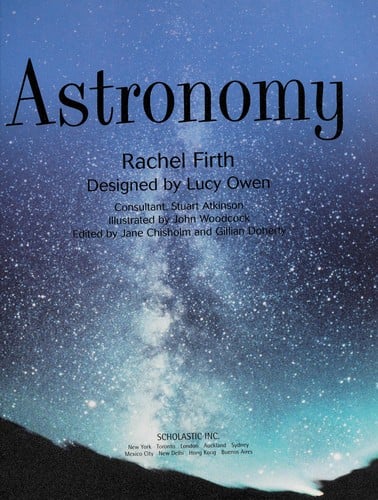
About This Book
Introduces concepts and provides basic information on formal and backyard astronomy, with simplified star maps for both hemispheres.
Wonderlit Review
Rachel Firth's 'Astronomy' is a well-structured, accessible non-fiction title from Usborne, aimed at introducing young readers to the vast and fascinating world of space. The book covers foundational astronomical concepts, including planets, stars, galaxies, and phenomena like black holes, presented in a clear, digestible manner. A notable feature is its inclusion of practical backyard astronomy tips and simplified star maps for both hemispheres, encouraging hands-on engagement with the subject. The book handles scientific topics directly, using straightforward language and engaging illustrations (typical of Usborne's informational series) to demystify complex ideas without oversimplifying them. The emotional arc is one of continuous wonder and discovery, fostering a sense of awe for the universe and empowering children with knowledge. This book is ideal for any child aged 4-11 who shows an early spark of curiosity about space, the night sky, or science in general. Parents might reach for this book when their child starts asking 'What are stars?' or 'Where do planets go?' or after a visit to a planetarium. For younger children (4-6), it serves as a fantastic read-aloud, with parents able to elaborate on concepts and point out details in the illustrations. Older children (7-11) can engage with it independently, using it as a reference or a springboard for further research. Parents should be prepared to answer follow-up questions, as the book is designed to ignite curiosity. There are no sensitive topics or scary scenes to preview. What sets this book apart from many other introductory astronomy books for children is its balance of theoretical knowledge with practical application, encouraging children not just to learn about space, but to look up and observe it themselves.
If Your Family Enjoyed This
Reviews
No reviews yet. Be the first to share how this book landed with your family.