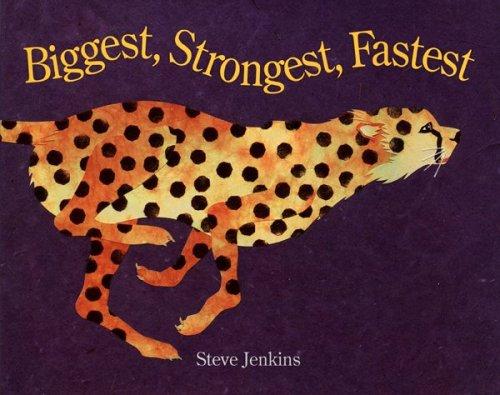
A parent should reach for this book when their child is in a phase of asking constant questions about the natural world, particularly 'what is the biggest, strongest, or fastest?'. This visually stunning book uses Steve Jenkins' signature cut-paper collage art to introduce young readers to the record-holders of the animal kingdom. It brilliantly satisfies a child's natural curiosity and wonder by presenting incredible facts in a way that is easy to understand, often comparing animal feats to human-scale experiences. Perfect for ages 4 to 8, it's a fantastic, engaging introduction to biology and scientific concepts that makes learning feel like pure discovery and entertainment.
The book is purely factual and secular. It implicitly touches on predator/prey dynamics (e.g., "fastest hunter," "strongest bite"), but does so in a scientific, non-graphic way. There are no depictions of violence or death. The approach is celebratory of nature's power.
Your experience helps other parents find the right book.
Sign in to write a reviewThe ideal reader is a 4- to 7-year-old fact-lover who is constantly asking about superlatives in nature. This child is fascinated by animals, numbers, and comparisons. They are likely a visual learner who will be captivated by the unique art style and the clear, powerful infographics.
No preparation is needed. The book can be read cold. The concepts are explained clearly and the visual comparisons are intuitive. Parents should be prepared for an enthusiastic burst of follow-up questions and a potential desire to learn more about these animals. A parent has just heard their child ask, "What's the biggest animal in the world?" or "Who is stronger, a gorilla or a beetle?" The child is demonstrating a curiosity about the extremes of the natural world and is ready for concrete, amazing answers.
A younger child (4-5) will focus on the bold illustrations and the single amazing fact per page. They will grasp the core concepts of "biggest" or "strongest" and love pointing out the animals. An older child (6-8) will engage more with the specific data and the scale comparisons. They will better understand the ratios (e.g., how a flea's jump compares to a human's) and may use the book as a reference or a jumping-off point for further research.
Steve Jenkins' cut-paper collage artwork is the book's most defining feature. It provides a unique texture and artistic depth not found in photographic nonfiction. His second key differentiator is the genius use of relatable scale. By comparing an animal's ability to a human equivalent, he makes abstract, incredible facts concrete, memorable, and truly awe-inspiring for a young audience.
This nonfiction book presents a survey of animals that are record-holders in various categories: biggest, strongest, fastest, longest tongue, and so on. Each two-page spread highlights a different animal, such as the saltwater crocodile or the flea, with a beautiful and intricate cut-paper collage illustration. The text provides a key fact about the animal's ability, often contextualized with a relatable comparison to something a child would understand, like a person or a car. A final spread provides a to-scale chart of all the animals featured.
This overview was generated by AI based on the book's content and reviews, and may not capture every nuance.
