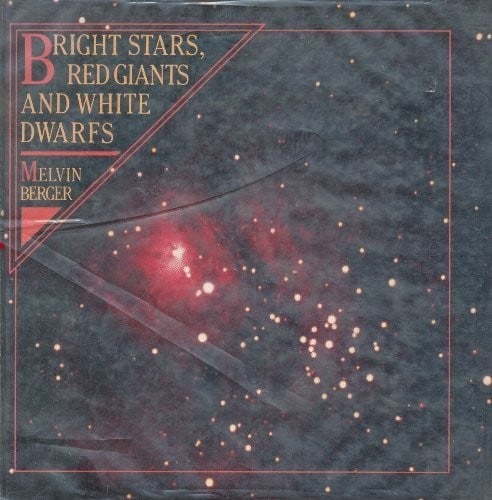
Melvin Berger's 'Bright Stars, Red Giants, and White Dwarfs' serves as a solid, foundational text for young readers curious about astronomy. The book systematically outlines the life cycle of stars, from their nebulous birth to their dramatic deaths as red giants, white dwarfs, or even black holes. It handles complex scientific topics with clear, straightforward language, making it digestible for its target age range. The book also bravely tackles theories about the ultimate fate of the universe, presenting concepts like the 'Big Crunch' or 'Big Freeze' in an age-appropriate manner, fostering a sense of wonder rather than fear.
The emotional arc of the book is one of gentle discovery and intellectual stimulation. It starts with basic observations and builds towards grander, more speculative ideas, maintaining an uplifting and hopeful tone about the vastness of knowledge. This book is specifically for children who are beginning to ask 'how' and 'why' about the natural world, particularly those with an early interest in space, science, or the night sky. A parent might reach for this book when their child points to a star and asks, 'What is that?' or after a visit to a planetarium.
Parents should preview the sections on the 'death' of stars and the 'end' of the universe, as these concepts, while presented gently, might spark further questions or mild anxiety in very sensitive younger children. For a 4-year-old, it's a perfect read-aloud to introduce vocabulary and concepts, while an 11-year-old could read it independently and use it as a springboard for further research. What sets this book apart from many other introductory space books is its specific focus on stellar evolution and cosmology, rather than just planets or constellations, offering a deeper dive into the fundamental building blocks of the cosmos.