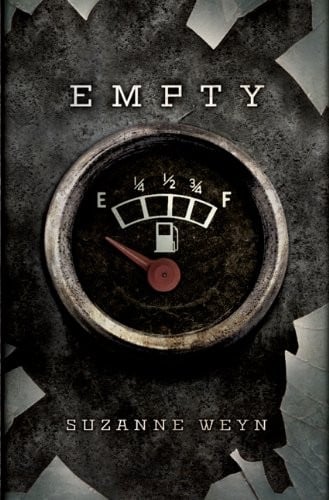
About This Book
When oil supplies run out and global warming leads to devastating storms, classmates Tom, Niki, Gwen, Hector, and Brock realize that the world as they know it is ending and lead the way to a more environmentally-friendly society.
peril_danger
Scary Scenes
environmental_themes
Wonderlit Review
Suzanne Weyn's "Empty" depicts a future where fossil fuels are depleted and climate change has led to severe weather. A group of five diverse classmates, Tom, Niki, Gwen, Hector, and Brock, are faced with the collapse of their familiar world. Instead of succumbing to despair, they take on the challenge of establishing a new, sustainable society. The book addresses the serious topics of environmental collapse and resource depletion directly, but through the lens of children's agency and problem-solving. It doesn't shy away from the consequences but focuses on proactive solutions rather than just the bleakness. The story begins with a sense of impending doom and crisis, shifting to a mood of determination and hope as the children begin to rebuild. It's an arc of challenge and triumph, emphasizing resilience. This book is ideal for children aged 8-11 who are beginning to grapple with environmental issues, enjoy adventure stories, and are inspired by characters who take initiative. It's particularly good for kids interested in science, social justice, and how communities can adapt. A parent might pick up "Empty" when their child expresses concern about climate change or environmental problems, or when they are looking for a story that models teamwork, problem-solving, and resilience in the face of large-scale challenges. It's also a good choice for a child who enjoys survival or dystopian-lite narratives. Parents might want to discuss the concepts of finite resources, global warming, and community building before or during reading. The "world ending" premise can be intense, so reassuring children about the fictional nature and the hopeful outcome is helpful. Younger readers (7-8) might focus more on the adventure and the immediate challenges the characters face, while older readers (9-11) will likely engage more deeply with the environmental themes, the societal implications, and the ethical questions raised by the collapse and rebuilding. Unlike many environmental books that focus solely on the problems, "Empty" provides a narrative where children are the primary agents of change, offering a sense of empowerment and practical, albeit fictionalized, solutions. It blends a dystopian setting with a strong message of hope and collective action.
If Your Family Enjoyed This
Reviews
No reviews yet. Be the first to share how this book landed with your family.