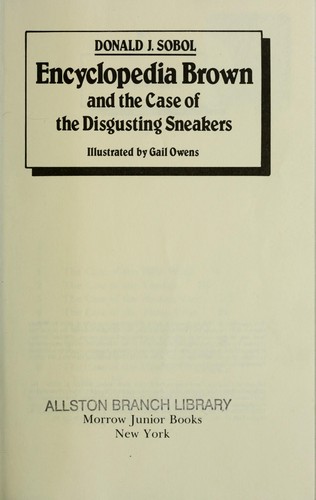
A parent might reach for this book when their child is ready for a more interactive reading experience that challenges them to think critically. Encyclopedia Brown is not a passive story; it's a collection of ten short, solvable mysteries that invite the reader to play detective alongside Leroy "Encyclopedia" Brown, a ten-year-old sleuth who solves neighborhood crimes with his impressive brainpower and keen observation skills. Each case presents a puzzle, and readers are encouraged to spot the flaw in the culprit's story before turning to the back of the book for the solution. This book champions curiosity, justice, and intellectual confidence. It shows children that knowledge is a superpower and that careful thinking can right wrongs, making it an excellent choice for nurturing analytical skills in a fun, low-stakes format.
There are no significant sensitive topics. The "crimes" are very mild (minor theft, lying, scams) and resolved without any real danger or deep emotional distress. The approach is entirely secular and focused on logic and observation. Resolution is always hopeful and clear-cut: the mystery is solved, and justice (in a neighborhood sense) is served.
Your experience helps other parents find the right book.
Sign in to write a reviewA 7 to 10-year-old who loves puzzles, riddles, and "I Spy" type games. This is perfect for the child who is starting to enjoy logical challenges and has a strong sense of fairness. It is also great for reluctant readers, as the short chapters and interactive format provide quick, rewarding victories. An ideal reader is one who likes to feel smart and enjoys being "in on the secret."
No prep is needed. The book can be read cold. The only "prep" might be explaining to the child the format: read the case, try to solve it, then flip to the back to check the answer. Parents might enjoy reading and solving the cases along with their child. A parent overhears their child saying "That's not fair!" or sees them meticulously trying to solve a puzzle in a magazine. The parent notices their child enjoys pointing out small details or inconsistencies in stories or real-life situations and wants to channel this energy into a positive reading experience.
A younger reader (7-8) will enjoy the humor and the satisfaction of getting the answer, even if they need help spotting the clue. They focus on the story and the "aha!" moment. An older reader (9-10) will be more engaged in the logical challenge itself. They will actively try to beat Encyclopedia to the solution, honing their deductive reasoning and learning to look for specific types of logical fallacies or factual errors.
The interactive format is its key differentiator. Unlike most mystery series where the reader is a passive observer, Encyclopedia Brown directly challenges the reader to solve the case with the exact same information the protagonist has. The separation of the story from its solution is a unique, game-like mechanic that makes reading an active, rather than passive, form of entertainment.
Boy detective Leroy "Encyclopedia" Brown solves a series of ten short, self-contained mysteries in his town of Idaville. Each chapter presents a case, from stolen goods to neighborhood squabbles, often involving the local bully Bugs Meany. Encyclopedia listens to the facts, observes the scene, and finds the single, logical inconsistency that solves the case. The reader is challenged to solve it before the solution is revealed in the back of the book. The titular case involves a contest for the most disgusting sneakers.
This overview was generated by AI based on the book's content and reviews, and may not capture every nuance.