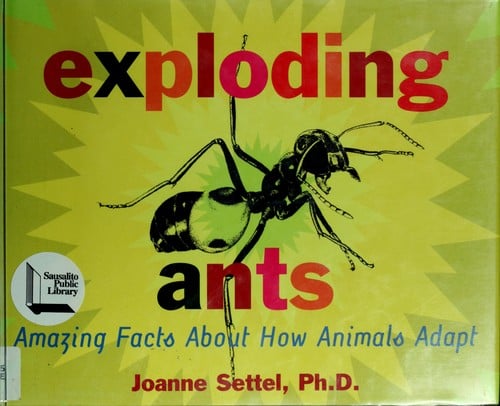
Joanne Settel's 'Exploding Ants: Amazing Facts About How Animals Adapt' is a wonderfully engaging non-fiction book that uses the inherent fascination with 'gross' things to teach valuable lessons about animal biology and adaptation. The book presents a series of short, digestible chapters, each focusing on a different animal behavior that might seem disgusting to humans, such as wasps laying eggs in caterpillars, head lice on human hair, or frogs using their eyeballs to swallow. Rather than just presenting these facts for shock value, Settel consistently frames them within the context of scientific adaptation, explaining *why* these behaviors are crucial for survival, finding food, or ensuring safety.
The book handles potentially sensitive topics like parasites and predation with a matter-of-fact, scientific tone, avoiding sensationalism while still acknowledging the 'gross' factor that appeals to young readers. The emotional arc is one of initial surprise or mild revulsion, quickly transitioning to wonder and appreciation for nature's ingenuity. It starts with intriguing, slightly shocking facts and ends with a deeper understanding of ecological balance and animal resilience.
This book is specifically for the curious child, particularly those who are drawn to animals, science, and the more unusual aspects of the natural world. It's an excellent choice for a parent whose child is asking 'why' about animal behaviors, or for a teacher looking for engaging examples of adaptation. Parents should be prepared for questions about the more graphic descriptions, such as larvae eating a caterpillar's guts, but can reassure children that these are natural processes. Younger children (4-7) will likely be captivated by the 'gross' details and the sheer wonder of the facts, while older children (8-11) will better grasp the underlying scientific principles of adaptation and survival. What sets this book apart is its direct embrace of the 'gross' as a gateway to scientific understanding, making it particularly appealing to reluctant readers who might shy away from more traditional science texts.