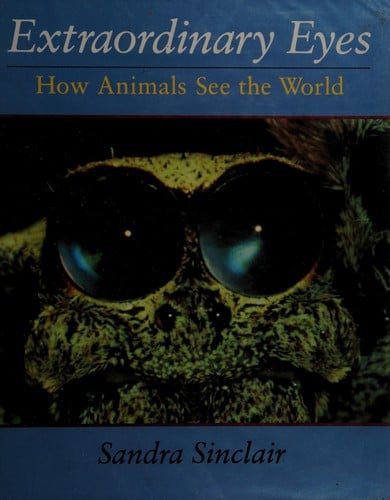
About This Book
Describes how vision works and compares and contrasts the eyes of such animals as the honeybee, fish, frog, and bird.
Wonderlit Review
Sandra Sinclair's 'Extraordinary Eyes' offers a concise yet engaging introduction to the science of vision, specifically focusing on how various animals perceive their surroundings. The book begins by explaining the basic mechanics of sight before diving into specific examples like the honeybee's compound eyes, the fish's underwater adaptations, the frog's motion-detecting vision, and the bird's keen eyesight. The comparative approach is effective, highlighting the diversity of nature's solutions to the challenge of seeing.
This book handles a scientific topic with clarity, making it accessible for young readers without oversimplifying. The emotional arc is one of sustained wonder and curiosity, encouraging children to marvel at the natural world. It's particularly well-suited for children aged 4-7 as a read-aloud, where parents can elaborate on concepts, and for 8-11 year olds as an independent read. A parent might reach for this book when their child expresses curiosity about animals, asks 'how' questions about the natural world, or as a supplement to an early science curriculum. No specific scenes require previewing, as the content is purely informative and gentle. Younger children will enjoy the animal examples and the idea of seeing differently, while older children can grasp the scientific concepts more deeply. What sets this book apart is its direct, comparative focus on vision, providing a unique lens through which to appreciate animal adaptations.
If Your Family Enjoyed This
Reviews
No reviews yet. Be the first to share how this book landed with your family.