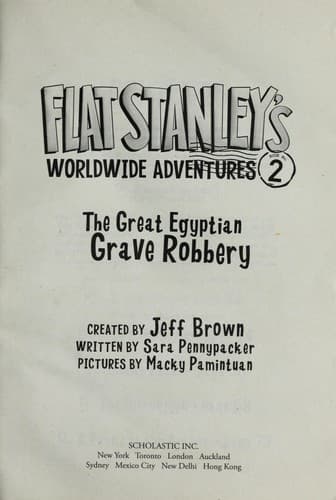
Stanley Lambchop's life takes an extraordinary turn when he is flattened by a bulletin board. Rather than being a hindrance, his new half-inch thickness opens up a world of imaginative possibilities. Stanley slides under locked doors, gets rolled up for easy transport, is flown like a kite by his younger brother Arthur, and even mails himself in an envelope to visit friends in California. His most heroic act involves disguising himself as a painting to help catch art thieves at a museum. Eventually, Stanley grows tired of his flatness, and Arthur ingeniously restores him to his original shape with a bicycle pump.
The book handles the unusual premise with lighthearted humor and a focus on creative problem-solving. The initial accident is not traumatic, and any peril, such as the art thieves, is presented in a low-stakes, almost comical manner, making it entirely suitable for young readers. The emotional arc is one of adaptation and discovery, moving from an unexpected change to joyful exploration of new abilities, and finally, a contented return to normalcy, enriched by unique experiences. The tone remains consistently uplifting and playful throughout.
"Flat Stanley" is ideal for early elementary readers, typically ages 6-9, who are ready for their first chapter books. It's perfect for children who enjoy whimsical stories, imaginative scenarios, and characters who embrace their individuality. Parents will find it an excellent choice for a read-aloud that sparks creativity and discussion about adapting to new situations or celebrating differences. No specific preparation is needed, as the content is gentle and engaging. Younger children will delight in the absurdity and simple adventures, while older readers can appreciate the humor and the underlying message of resilience. This book stands out as a classic due to its iconic premise, which has inspired the real-world "Flat Stanley Project," fostering literacy and cultural exchange. Its enduring appeal lies in its straightforward storytelling, the sheer fun of Stanley's predicament, and its subtle encouragement to make the best of any situation.