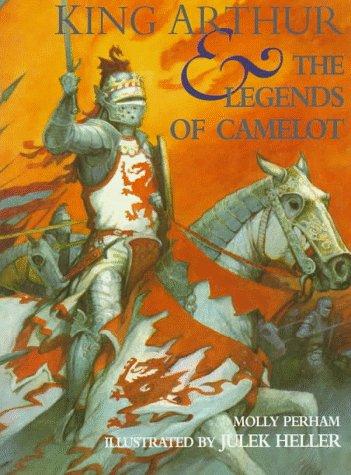
For the child enchanted by tales of valiant knights and powerful magic, this book brings the legendary world of King Arthur to life, exploring themes of honor and destiny.
A parent might reach for this book when their child is captivated by the idea of heroes and legends, and is ready for a story with more depth than a simple fairy tale. This book is an accessible retelling of the classic legend of King Arthur, from his humble beginnings as a boy known as Wart, to the magical moment he pulls the sword Excalibur from the stone and claims his destiny as the High King of Britain. It introduces the wise wizard Merlin, the noble Knights of the Round Table, and the founding of the idyllic kingdom of Camelot. The story explores powerful themes of honor, destiny, leadership, and the struggle between good and evil. Written for middle-grade readers, it serves as a perfect introduction to one of the most foundational stories in Western literature, inspiring a sense of wonder and adventure.
The book deals with medieval combat and death. The violence is direct (knights joust, battles are fought with swords) but is not graphic or gory, fitting the heroic fantasy genre. Character deaths occur within the context of battle and are presented as a consequence of conflict rather than a source of trauma. The resolution of this part of the story is hopeful, focusing on the establishment of a golden age, though the broader Arthurian legend is tragic.
Ideal Reader
The ideal reader is an 8 to 11-year-old who loves fantasy and adventure stories. They have likely moved past simpler fairy tales and are ready for a continuing narrative with a larger cast of characters and more complex ideas like honor and justice. This child is fascinated by knights, castles, magic, and the idea of a young person discovering a great destiny.
Parent Prep
Parents should be prepared for classic fantasy violence. While not graphic, the book contains descriptions of battles and jousting. It would be helpful to provide context that this is a legend, a foundational myth that has been retold for centuries, not a literal history book. No other significant prep is needed; it's a solid introduction to the topic. A parent notices their child asking questions about what makes someone a good leader, what it means to be brave, or showing a deep interest in medieval fantasy through games, movies, or their own imaginative play. The child might be looking for a hero to admire.
Age Experience
A younger reader (8-9) will primarily connect with the magic and action: Merlin's wizardry, pulling the sword from the stone, and the excitement of knightly quests. An older reader (10-12) will begin to appreciate the more nuanced themes: the burdens of leadership, the importance of a justice system (the Round Table), and the challenge of uniting a divided country.
What Makes It Special
Among the vast number of Arthurian retellings, this book's strength is its accessibility for the middle-grade chapter book reader. It's more textually complex than a picture book but avoids the dense, mature themes and tragic scope of classics like T.H. White's 'The Once and Future King'. It serves as a perfect, self-contained entry point focused on the heroic and hopeful beginning of the legend.
Read plot summary
This book is a straightforward adaptation of the early King Arthur legends for a middle-grade audience. It covers Arthur's mysterious childhood under the tutelage of the wizard Merlin, the famous 'sword in the stone' scene which reveals his royal destiny, his struggle to be accepted by the warring lords of Britain, and the establishment of Camelot and the Knights of the Round Table. The narrative focuses on the foundational, optimistic phase of Arthur's reign, emphasizing the creation of a just and noble kingdom and the code of chivalry that guides his knights.
This overview was generated by AI based on the book's content and reviews, and may not capture every nuance.
Discussion Prompts
1
Merlin knew Arthur was destined to be king, but he let him grow up not knowing the truth. Why do you think he made that choice? Was it fair to Arthur?
2
The Code of Chivalry was a set of rules for the Knights of the Round Table. If you were creating a 'code' for your classroom or friends, what would be your top three most important rules?
3
When Arthur first pulled the sword from the stone, many of the older lords refused to accept a young boy as their king. What qualities did Arthur show that eventually won them over?
4
The Round Table was designed so that no knight sat at the 'head' of the table. What do you think this symbolized about Arthur's style of leadership and how he viewed his knights?