About This Book
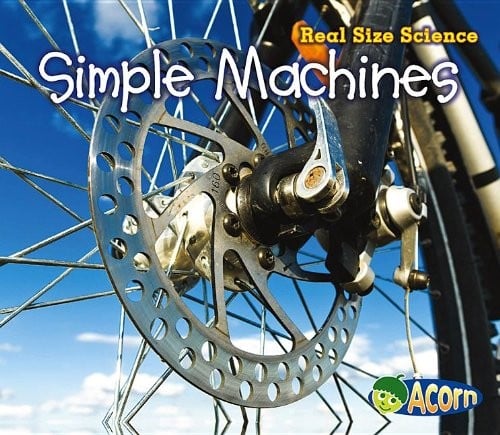
"Simple Machines: Real Size Science" offers a unique and highly visual approach to introducing fundamental physics concepts to children aged 4-11. Instead of relying solely on text, the book utilizes striking, accurately-sized photographs to demonstrate how simple machines like levers, pulleys, and wheels look and function in the real world. This innovative method helps children understand abstract ideas of scale and proportion, making complex mechanical principles accessible and engaging. It's an excellent resource for sparking curiosity about engineering and the mechanics of everyday objects.
This title utilizes real-size photographs to teach young learners about simple machines. Instead of explaining in words alone how machines look and function, the book conveys information about scale, proportion, and use with accurately-sized photographs.
Wonderlit Review
Simple Machines: Real Size Science by Rebecca Rissman is a standout nonfiction picture book that tackles the foundational concepts of physics with remarkable clarity and visual appeal. The book introduces young readers to various simple machines, such as levers, pulleys, inclined planes, wedges, screws, and wheels and axles. Its most distinctive feature is the use of "real-size" photographs, which allows children to truly grasp the scale and function of these machines in a way that traditional illustrations or abstract explanations often cannot. The book handles its scientific topic directly and accessibly, without any sensitive content. The emotional arc is one of discovery and empowerment, as children move from perhaps not understanding how everyday objects work to gaining a fundamental insight into mechanical principles. This book is specifically for curious children, visual learners, and those who are beginning to ask "how does that work?" about the world around them. A parent might reach for this book when their child shows an interest in building, engineering, or simply understanding the mechanics behind common tools and toys. To enhance the experience, parents could prepare by gathering a few household items that exemplify simple machines, like a spoon (lever), a ramp (inclined plane), or a doorknob (wheel and axle), to demonstrate the concepts physically. Younger children (ages 4-6) will primarily engage with the striking photographs and the basic identification of machines, while older children (ages 7-11) will be able to delve deeper into the explanations of how each machine reduces effort or changes the direction of force. What sets this book apart from others on simple machines is its commitment to the "real-size" visual, which provides an unparalleled sense of tangibility and connection to the physical world, making abstract scientific ideas concrete and memorable.
More in Real Size Science
If Your Family Enjoyed This

Reviews
No reviews yet. Be the first to share how this book landed with your family.