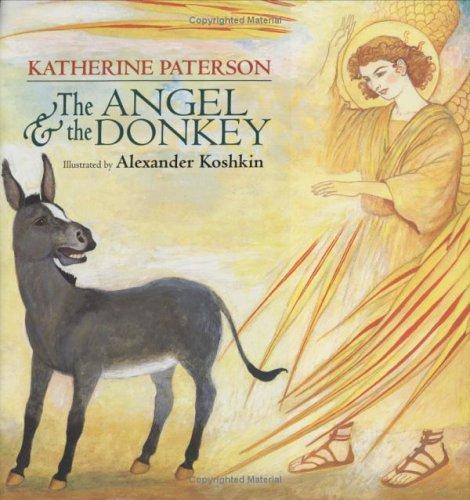
About This Book
A soothsayer and his faithful donkey save the Israelites from destruction by King Balak on the orders of an angel.
peril_danger
Wonderlit Review
Katherine Paterson's 'The Angel and the Donkey' offers a gentle and accessible retelling of the biblical story of Balaam and his talking donkey. The narrative follows a soothsayer, Balaam, who is hired by King Balak to curse the Israelites. On his journey, his faithful donkey repeatedly sees an angel blocking their path, though Balaam remains unaware. When the donkey tries to avoid the unseen obstacle, Balaam becomes frustrated and strikes the animal. In a miraculous turn, the donkey speaks, questioning Balaam's actions, which then opens Balaam's eyes to the angel's presence. The angel instructs Balaam to only speak what God tells him, ultimately leading Balaam to bless the Israelites instead of cursing them.
The book handles the potentially sensitive topic of a king intending destruction and the donkey being struck with remarkable gentleness. The focus is on divine intervention and the miraculous, rather than any prolonged conflict or violence. The religious aspect is presented as an integral part of the narrative, emphasizing moral lessons of obedience and listening to unexpected sources of wisdom, rather than being overtly preachy.
The emotional arc begins with a mission of potential harm, moves through a moment of confusion and conflict, and then shifts to wonder and divine guidance, culminating in a hopeful resolution where good prevails. It's an arc of revelation and obedience, designed to be comforting and inspiring.
This book is specifically for children aged 3-7, particularly those in religious households or those interested in stories of faith, miracles, and animal heroism. It's an excellent choice for children learning about obedience, listening to inner or outer guidance, and the idea that even the humblest creatures can be instruments of good. Parents might reach for this book when introducing biblical stories, discussing themes of listening, obedience, or when a child is curious about angels or talking animals. It serves as a gentle, morally instructive read-aloud.
Parents might want to briefly explain the context of the Israelites and King Balak if their child is unfamiliar with the broader biblical narrative. The scene where the donkey is struck by Balaam could be a point for discussion about frustration and how the donkey's speaking changed Balaam's perspective. Younger children (3-5) will likely be captivated by the talking donkey and the angel, while older children (6-7) might grasp more of the moral implications, the concept of divine will, and the importance of listening. Katherine Paterson's masterful storytelling sets this book apart, bringing a classic, sometimes challenging, biblical narrative to life with sensitivity and clarity for a young audience, emphasizing the unexpected source of wisdom and the power of faithfulness.
If Your Family Enjoyed This

Reviews
No reviews yet. Be the first to share how this book landed with your family.