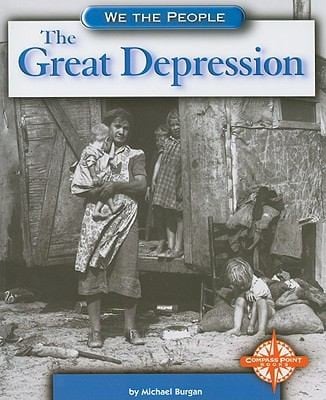
About This Book
Provides information on the history and effects that the Great Depression had on the United States people and the economy. Also explains President Franklin D. Roosevelt's "New Deal".
financial_hardship
Wonderlit Review
Michael Burgan's "The Great Depression" provides a concise and factual overview of one of America's most challenging historical periods. The book covers the causes and widespread effects of the Depression on the American people and economy, detailing the daily struggles faced by families across the nation. A significant portion is dedicated to President Franklin D. Roosevelt's "New Deal" and the government's efforts to bring relief and recovery.
The book handles the sensitive topic of widespread poverty and hardship in an age-appropriate manner, focusing on historical context and the national response rather than graphic details of suffering. It maintains a secular, educational tone, emphasizing economic and social history. The emotional arc moves from the somber reality of the Depression's onset to the challenges faced, ultimately concluding with the hopeful efforts of the New Deal and the eventual path to recovery, instilling a sense of national resilience.
This book is specifically for children in late elementary school, typically ages 8-11, who are beginning to study American history. It's an excellent resource for school projects, for children with a budding interest in how past events shaped the present, or for those curious about significant historical figures like FDR. A parent might reach for this when their child is studying the Great Depression in school, asks questions about historical economic hardship, or shows an interest in American history.
Parents should be prepared to discuss complex concepts such as unemployment, poverty, and government intervention. While the book is gentle, the underlying realities of the Depression can be heavy, so discussing how communities helped each other and the eventual recovery can provide a balanced perspective. Younger children (4-7) would likely find the concepts too abstract for independent reading, but could benefit from a read-aloud with significant parental explanation. Older elementary children (8-11) can read it independently, grasping the factual information and beginning to understand the societal implications. As a Capstone publication, it likely features clear, concise language and a structured format, often with historical photographs or illustrations, making complex topics digestible for its target audience. Its focus on the New Deal is particularly valuable for understanding the recovery efforts.
If Your Family Enjoyed This

Reviews
No reviews yet. Be the first to share how this book landed with your family.