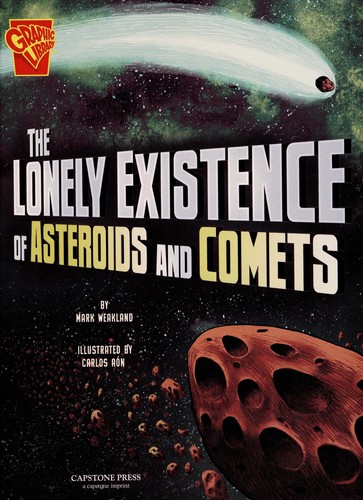
Reach for this book when your visually-oriented child is asking big questions about space, asteroids, and what's out there. 'The Lonely Existence of Asteroids and Comets' uses a dynamic graphic novel format to explain complex science in an accessible way, making it perfect for kids who love comics but might be intimidated by dense science texts. It covers the formation, composition, and differences between asteroids and comets, and even touches on their dramatic impact on Earth's history. Ideal for ages 8 to 12, this book channels a child's natural wonder into real scientific understanding, making it an excellent choice for reluctant readers or any kid who learns best through images.
The book directly discusses the mass extinction event that killed the dinosaurs. This is presented as a scientific fact, a natural consequence of a catastrophic cosmic event. The approach is entirely secular and informative, focusing on the cause (asteroid impact) and effect (global climate change, extinction). The tone is factual, not intentionally frightening or overly emotional.
This is for the 8 to 11-year-old who loves graphic novels and is obsessed with space facts. It's a perfect fit for a child who just watched a documentary about asteroids or dinosaurs and is hungry for more information, but would be put off by a text-heavy encyclopedia. It's also an excellent gateway to nonfiction for kids who think it's 'boring.'
Your experience helps other parents find the right book.
Sign in to write a reviewA parent might want to preview pages 24-25, which visually depict the asteroid striking Earth and the subsequent fallout for the dinosaurs. While not gory, it's a dramatic moment that could be a good starting point for a conversation about extinction and how life on Earth changes over vast timelines. The book can otherwise be read cold. A child asks, "What killed the dinosaurs?" or "Are we going to get hit by an asteroid?" or "What's the difference between a shooting star and a comet?" The parent is looking for a book that answers these questions accurately without inducing anxiety.
A younger reader (age 8-9) will be captivated by the dramatic visuals of space collisions and the dinosaur extinction narrative. They will easily grasp the core differences between asteroids and comets. An older reader (age 10-12) will absorb the more detailed scientific vocabulary (Oort Cloud, Kuiper Belt, nucleus, coma) and better appreciate the explanations of orbits and planetary formation, using it as a scaffold for more complex astronomy concepts.
Its graphic novel format is the key differentiator in a crowded field of space books. Instead of relying on photos or dense text, it uses the sequential art of comics to teach astrophysics. This narrative approach, led by a robot character, makes complex topics uniquely accessible and entertaining for visual learners and reluctant readers.
Narrated by a friendly robot guide, this graphic novel explains the origins of our solar system, the formation of the asteroid belt between Mars and Jupiter, and the distant Kuiper Belt and Oort Cloud. It clearly defines the composition of asteroids (rock and metal) versus comets (ice, dust, and rock), explains their different orbits, and discusses significant impacts. A key section is dedicated to the Chicxulub impactor that led to the mass extinction of the dinosaurs.
This overview was generated by AI based on the book's content and reviews, and may not capture every nuance.