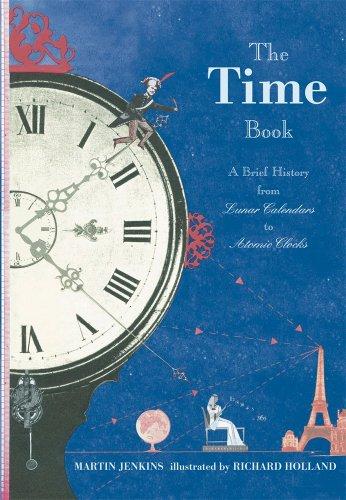
About This Book
"What is time? Where does it come from, what is it made of, and how do we know we've got it right? Read the wonderful and eccentric Time Book to find out."--Page 4 of cover.
Wonderlit Review
Martin Jenkins' "The Time Book" provides a captivating journey through the history of time measurement, making a complex concept accessible and engaging for young readers. The book starts by posing fundamental questions about time and then systematically explores the diverse methods humans have devised to track it, from ancient observations of the moon and sun to the precision of atomic clocks. It touches upon various cultural approaches and the scientific advancements that have shaped our understanding.
This book is purely informative and scientific, with no sensitive topics to navigate. Its emotional arc is one of gentle curiosity and growing understanding, consistently fostering a sense of wonder at human ingenuity. The tone is engaging and educational throughout.
"The Time Book" is ideal for children aged 4-11 who possess a natural curiosity about "how things work" or the origins of everyday concepts. It's particularly well-suited for those with an emerging interest in science, history, or engineering. A parent might reach for this book when a child asks profound questions like "What is time?" or "How do clocks work?", or when seeking a nonfiction title that blends science and history in an approachable manner. It's also an excellent resource for supplementing early STEM education at home.
No specific parent preparation is needed, as the book is straightforward and clear. Younger children (4-6) will enjoy the general concepts and the engaging illustrations, grasping the idea of different ways to mark time. Older children (7-11) will appreciate the historical progression, the scientific details, and the explanations of more complex timekeeping devices. What sets this book apart is its dedicated focus on the *measurement* of time, offering a unique blend of scientific explanation and historical narrative without becoming overly technical.
If Your Family Enjoyed This
Reviews
No reviews yet. Be the first to share how this book landed with your family.