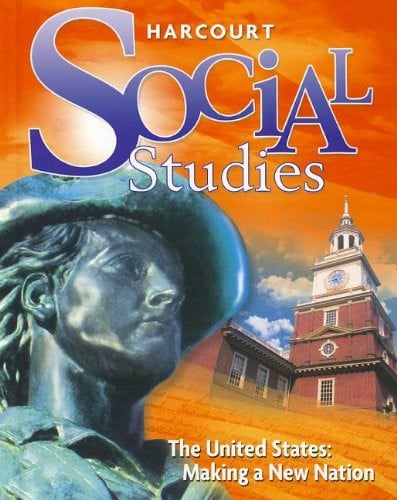
This book, 'The United States Making a New Nation,' by Harcourt School Publishers, is clearly designed as a comprehensive elementary school textbook or core curriculum resource. Its 720-page length for an age range of 4-11 indicates a deep dive into the subject, likely broken into manageable chapters with extensive supporting materials such as illustrations, maps, primary source excerpts, and activities. The content focuses on the foundational period of American history, encompassing early European colonization, the causes and events of the American Revolution, the drafting and ratification of the Constitution, and the early years of the republic. It also addresses crucial, often challenging, aspects of this era, including the displacement of Native American populations and the pervasive institution of slavery, presenting these as integral parts of the nation's complex origins. Sensitive topics like the Revolutionary War, conflicts with Native Americans, and slavery are handled factually, as expected in an educational text for this age group. The approach is likely to be age-appropriate, focusing on historical context and consequences rather than graphic details. The emotional arc of the book is generally uplifting and hopeful, celebrating the ideals of liberty and self-governance, while also acknowledging the struggles and injustices inherent in the nation's formation. This book is specifically for elementary school students learning American history, either in a classroom setting or for homeschooling. A parent would reach for this when their child is beginning to study U.S. history, particularly the colonial period through the early republic, or if they need a robust reference for a history project. Parents should preview sections on war and slavery to prepare for potential questions and discussions, ensuring they can provide additional context or emotional support if needed. Younger children (4-7) would experience this as a read-aloud, focusing on key stories and figures, while older children (8-11) could engage in independent reading and research, benefiting from the depth of information. What makes it different from other books on the topic is its comprehensive, textbook-style approach, offering a structured curriculum rather than a narrative story.