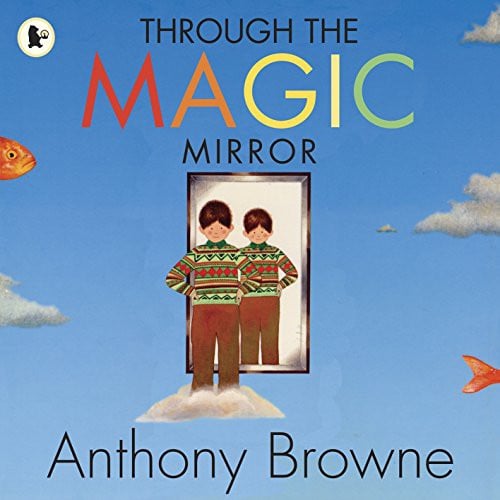
About This Book
A young boy steps through his mirror into a world which looks the same but is slightly different.
Scary Scenes
Wonderlit Review
Anthony Browne's 'Through the Magic Mirror' is a classic picture book that, despite its 'chapter book' classification (likely due to its length and depth for its time), functions beautifully as a read-aloud for younger children and an independent read for early elementary students. The story follows a young boy, Toby, who, feeling bored, steps through his bedroom mirror into a parallel world. This world is not overtly fantastical or dangerous, but rather a subtly altered version of his own, where familiar objects and people have slight, often humorous or thought-provoking, differences. This gentle surrealism is a hallmark of Browne's work.
The book handles the concept of an altered reality with a quiet, observational tone. There are no overt sensitive topics, but the idea of things being 'not quite right' might spark mild curiosity or a touch of unease in very sensitive children, which can be a valuable conversation starter about perception and comfort with the unknown. The emotional arc is one of quiet discovery and wonder, rather than high drama. It starts with boredom and transitions into a journey of subtle fascination, ending with a return to the familiar, perhaps with a new appreciation for it.
This book is specifically for children who enjoy imaginative play, quiet observation, and stories that make them think. It's a perfect choice when a parent wants to encourage creativity, discuss different perspectives, or simply share a beautifully illustrated, thought-provoking story. Parents should be prepared to discuss the 'differences' Toby encounters and what they might mean. Younger children (4-6) will enjoy the visual hunt for differences and the simple narrative, while older children (7-11) can delve deeper into the themes of reality, perception, and the power of imagination. What sets it apart is Browne's unique artistic style and his ability to create a sense of profound wonder and subtle mystery from seemingly ordinary alterations, making the familiar feel extraordinary.
If Your Family Enjoyed This
Reviews
No reviews yet. Be the first to share how this book landed with your family.