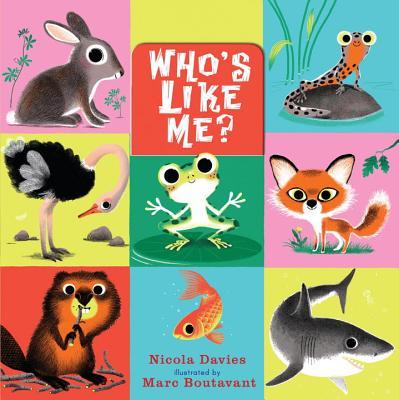
About This Book
Encourages readers to determine which animals are alike based on their physical characteristics and habitats.
Wonderlit Review
Nicola Davies's 'Who's Like Me?' is a charming and effective nonfiction picture book that introduces young readers to the concept of animal classification and comparison. The book presents various animals and prompts children to identify similarities based on physical traits and habitats, utilizing a lift-the-flap mechanism to reveal answers or related animals. This interactive format makes learning an engaging game rather than a dry lesson.
The book handles its educational content in a gentle, exploratory manner. It doesn't overwhelm with scientific jargon but rather encourages observation and critical thinking through visual cues and simple questions. The emotional arc is one of sustained curiosity and the joy of discovery, maintaining a light and playful tone throughout.
This book is ideal for preschoolers and early elementary children who are developing their observation skills and a nascent interest in the natural world. It's particularly well-suited for a child who enjoys interactive elements in books or who is beginning to ask 'why' and 'how' about animals. Parents will find it useful when looking for a book that combines entertainment with educational value, especially for a child who might be a reluctant learner of factual information. It's a perfect trigger moment for a parent wanting to foster early scientific inquiry or simply share a cozy, informative read-aloud.
Parents should preview the book to appreciate the interactive nature and be ready to engage with their child in the 'guessing game' aspect. The questions posed are straightforward, making it easy for adults to facilitate discussion. Younger children (ages 4-6) will enjoy the tactile experience of lifting flaps and the simple comparisons, while older children (ages 7-8) might delve deeper into the reasons behind the classifications and ask more complex questions about animal biology. What sets it apart from other animal books is its direct, interactive approach to classification, making the child an active participant in the learning process rather than a passive recipient of information.
If Your Family Enjoyed This
Reviews
No reviews yet. Be the first to share how this book landed with your family.