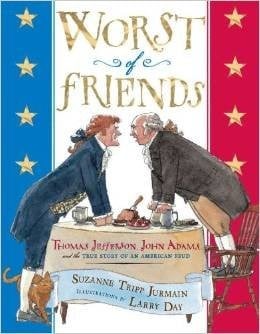
This 32-page chapter book, "Worst of Friends," offers a compelling and accessible introduction to the complex relationship between two pivotal figures in American history, Thomas Jefferson and John Adams. The book skillfully navigates their journey from initial friendship and collaboration to a profound political rivalry, driven by their contrasting visions for the nascent United States. It highlights their distinct personalities and the ideological differences that led them to become leaders of opposing parties, bringing their "feud" to the White House.
The book handles the sensitive topic of political disagreement and personal conflict in a straightforward, age-appropriate manner. It doesn't shy away from the intensity of their rivalry but frames it within the context of nation-building. The emotional arc moves from camaraderie to tension and conflict, implicitly leading to a later understanding or reconciliation (though the description doesn't explicitly state the reconciliation, it's a known historical fact that they later corresponded warmly, which is usually part of this story).
This book is specifically for children who are beginning to show an interest in history, government, or the concept of differing opinions. It's also excellent for a child who might be experiencing conflict with a friend or grappling with the idea that people they respect can disagree strongly. A parent might reach for this book when their child asks "Who were the Founding Fathers?" or "Why do people disagree about politics?" or even "Can friends argue and still be friends?"
Parents should be prepared to discuss the nature of political parties and the idea that even great leaders can have strong disagreements. It's an opportunity to talk about respectful debate and the importance of different perspectives in a democracy. For younger children (4-6), the focus might be more on the friendship and the idea of differing ideas. For older children (7-11), discussions can delve deeper into the historical context, the formation of political parties, and the impact of their leadership. What sets this book apart is its focus on the *relationship* between these two figures, rather than just their individual biographies, making the historical narrative more personal and relatable.