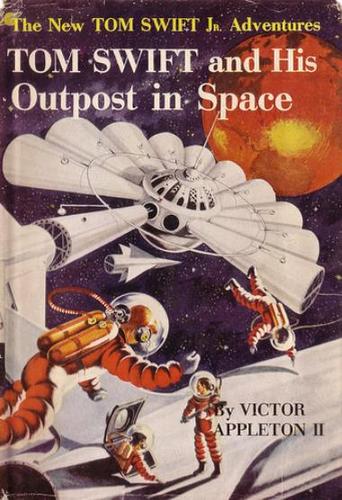
For the child who loves imagining new technologies and solving big problems, this classic adventure delivers thrilling innovation and courageous discovery.
A parent might reach for this book when their child shows a spark of ingenuity and a love for adventure, and needs a story that celebrates brilliant problem-solving. This classic mid-century sci-fi adventure follows Tom Swift Jr., a young genius inventor who creates an 'Aquatomic Tracker' to find a lost rocket nose cone at the bottom of the ocean. He and his friends must race against villainous spies from a rival nation, using an array of futuristic gadgets and vehicles to secure the prize. The story champions themes of curiosity, self-confidence, and teamwork. It’s a great fit for independent readers who enjoy fast-paced plots and technical details over deep emotional complexity, offering a thrilling and optimistic vision of what technology can achieve.
Action involves sabotage and capture, but it is non-graphic and cartoonish in nature.
Cultural Content GapMild
The book reflects 1960s Cold War attitudes with stereotypical foreign villains.
Sensitive Topics
The book reflects its 1964 Cold War origins. The primary sensitive issue is the stereotypical, one-dimensional portrayal of the foreign 'Brungarian' spies as bumbling yet sinister antagonists. This is a cultural content gap that presents a simplistic 'us vs. them' worldview. The approach is entirely secular, and the resolution is a clear, unambiguous victory for the American heroes.
Ideal Reader
The ideal reader is a 9 to 12-year-old who is fascinated by mechanics, engineering, and invention. This child likely enjoys building with LEGOs, playing sandbox games like Minecraft, or taking things apart to see how they work. They prefer plot-driven stories with clear heroes and villains and get excited by detailed descriptions of fantastic machines and gadgets.
Parent Prep
A parent might want to provide brief context about the 1960s and the Cold War to explain the political backdrop and the simplistic depiction of foreign spies. It's a good opportunity to discuss how adventure stories and villains have changed over time. Otherwise, the book can be read cold as a straightforward adventure. A parent has noticed their child's strong interest in STEM subjects. The child constantly asks 'how does that work?' or is already sketching their own inventions. The parent is looking for a book that will fuel this curiosity and provide a positive, intelligent role model who uses his mind to solve big problems.
Age Experience
A younger reader (9-10) will be captivated by the high-tech gadgets, the underwater setting, and the fast-paced action. The 'good guys vs. bad guys' dynamic is easy to follow. An older reader (12-14) may find the characters flat and the science dated (e.g., the casual use of 'atomic' energy), but can appreciate it as a piece of retro-futurism and a classic example of the techno-thriller genre.
What Makes It Special
Unlike contemporary youth sci-fi that often explores dystopian themes or complex moral ambiguity, Tom Swift Jr. is a prime example of optimistic techno-solutionism. Its core belief is that American ingenuity and technological advancement are inherently good and can solve any problem. It is a celebration of invention and competence, pure and simple.
Read plot summary
Teenage genius Tom Swift Jr. invents an Aquatomic Tracker, a device capable of locating specific radioactive isotopes from a great distance. His invention is immediately put to the test when a US space probe's experimental nose cone is lost in the deep ocean. Tom, along with his friend Bud Barclay and his father, must use their fantastic array of vehicles, including the flying lab Sky Queen and the submarine Seacopter, to retrieve the nose cone. Their mission becomes a race against time as they are pursued by spies from the hostile nation of Brungaria, who want the advanced technology for themselves. The story is a series of technical challenges, clever escapes, and underwater confrontations.
This overview was generated by AI based on the book's content and reviews, and may not capture every nuance.
Discussion Prompts
1
Tom's Aquatomic Tracker is a brand new invention. If you could invent a machine to solve one problem at your school or in your town, what would it do and what would you call it?
2
Tom relies on his friend Bud Barclay throughout the adventure. What important skills did Bud bring to the mission? Why is teamwork important, even for a genius like Tom?
3
The story was written in 1964 and imagined a future full of atomic-powered gadgets. What technology in the book seemed the most futuristic or exciting to you? How is it different from the technology we have today?
4
The Brungarian spies were trying to steal Tom's technology. Do you think it's ever okay to keep new inventions a secret? Why or why not?