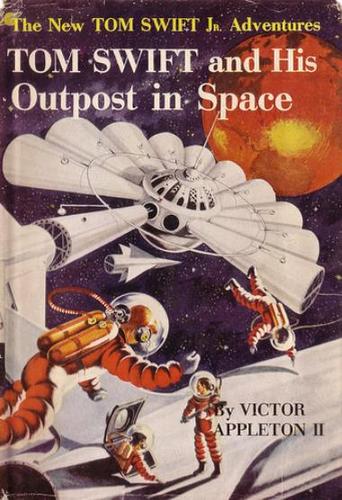
A parent might reach for this book when their child dreams of space exploration and building incredible machines. It's for the young tinkerer who needs a story that champions ingenuity and scientific problem-solving. "Tom Swift and His Outpost in Space" follows the brilliant young inventor Tom Swift Jr. as he constructs a revolutionary space station. He must overcome sabotage, cosmic dangers, and complex engineering hurdles. The story celebrates curiosity, perseverance, and teamwork, showing how challenges are met with courage and cleverness. Perfect for readers aged 9-14, this classic sci-fi adventure is an excellent choice for encouraging an interest in STEM and inspiring a belief that big ideas can change the world.
Reflects 1950s Cold War-era nationalism and stereotypical foreign villains.
Sensitive Topics
The book is a product of its time (1955), and its primary sensitivity is its cultural context. The antagonists are one-dimensional foreign spies ("Brungarians"), reflecting Cold War-era stereotypes and nationalism. The approach is secular and action-focused. The resolution is entirely triumphant and hopeful, with no moral ambiguity.
Ideal Reader
A 10-12 year old who is fascinated by engineering, space, and how things work. This reader loves building complex LEGO sets or designing worlds in Minecraft and is drawn to competent heroes who solve problems with their intellect. They enjoy clear good-versus-evil narratives and stories that celebrate invention.
Parent Prep
Parents should be prepared to discuss the dated Cold War context, including the stereotypical portrayal of the foreign villains. The science itself is also a product of the 1950s (e.g., reliance on atomic power, vacuum tubes), which can be a great opportunity to discuss how technology and scientific understanding have evolved. The book can be read cold, but these context conversations will enrich the experience. A parent has a child who is suddenly obsessed with space after a trip to a science museum or watching a documentary about NASA. The child is constantly asking how rockets work or sketching their own inventions and needs a story that channels that constructive curiosity into an exciting adventure.
Age Experience
A younger reader (9-11) will be thrilled by the high-tech gadgets, the space adventure, and the clear-cut heroics. They will likely take the science at face value. An older reader (12-14) will still enjoy the grand scale of the inventions but may find the characters a bit flat. They are more likely to notice the dated social attitudes and technology, which can lead to more critical thinking about the text as a historical artifact.
What Makes It Special
Unlike much of modern youth sci-fi that leans towards dystopia or complex social commentary, this book is a prime example of mid-century American techno-optimism. Its unique quality is its pure, unbridled enthusiasm for scientific progress as a heroic endeavor. The focus is less on the emotional journey and more on the sheer joy of invention and the competence of its brilliant young hero.
Read plot summary
Brilliant 18-year-old inventor Tom Swift Jr. designs and builds a massive, wheel-shaped space station, the "Outpost in Space," to serve as a refueling depot and a platform for a powerful solar energy condenser. With his friends, he faces numerous challenges including industrial sabotage from foreign agents, the dangers of space radiation, and critical technical failures. The plot follows the construction, launch, and defense of the station, culminating in Tom successfully thwarting the villains and proving his invention's success.
This overview was generated by AI based on the book's content and reviews, and may not capture every nuance.
Discussion Prompts
1
Tom's space station is designed to harness solar energy. How does his 1955 idea for using solar power in space compare to how we use it today on the International Space Station and satellites?
2
Tom is incredibly smart and confident. Do you think he's ever scared? When in the story might he have been hiding his fear, and why is it important for a leader to appear brave?
3
Tom couldn't have built the Outpost alone. What were some of the most important contributions from his friends, like Bud Barclay and 'Chow' Winkler? Why was their teamwork essential for success?
4
The villains in the story repeatedly try to steal Tom's inventions. Why do you think protecting scientific ideas and inventions is important for progress?