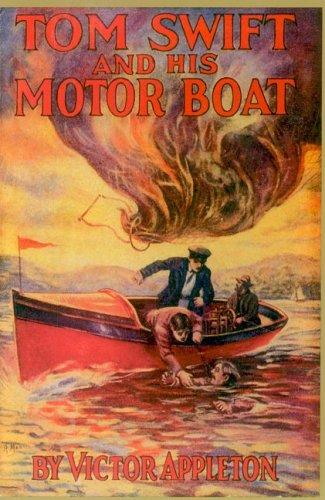
A parent might reach for this book when their child shows a spark for invention and a love for fair competition, but is perhaps feeling discouraged by a rival or a challenging project. This classic story follows Tom Swift, a brilliant young inventor who designs and builds a revolutionary electric motorboat. His success attracts the envy of a local bully, Andy Foger, who will stop at nothing to sabotage Tom's chances in the big race on Lake Carlopa. The book is a wonderful celebration of ingenuity, perseverance, and integrity in the face of adversity. It's an ideal read for curious minds aged 9 to 14, offering a wholesome adventure that champions cleverness and hard work over dishonesty.
The book reflects early 20th-century technology, language, and social norms.
Sensitive Topics
The book's primary sensitivity is its historical context. Published in 1910, it reflects the social norms, language, and gender roles of that era, which can feel dated. The approach to conflict is a very direct, secular, good-versus-evil narrative with little moral ambiguity. The resolution is predictably hopeful, with the virtuous and intelligent hero triumphing over the dishonest bullies. There is no death, divorce, or complex identity exploration.
Ideal Reader
This is for the 10- to 13-year-old tinkerer. The child who loves taking things apart to see how they work, who excels at LEGOs or Minecraft, and who is fascinated by mechanics and engineering. It's perfect for a reader who enjoys a straightforward adventure with a clear hero and villain, and who appreciates detailed descriptions of technical processes.
Parent Prep
A parent should preview the book to be prepared for the old-fashioned language and social context. A brief conversation explaining that this book was written over a century ago can help frame the story. The characters are archetypes (the brilliant hero, the bumbling sidekick, the one-dimensional bully), which a parent could use as a jumping-off point to discuss how characters in books have changed over time. It can be read cold, but context enhances the experience. A parent sees their child growing frustrated with a long-term school project or a competition (like a science fair or sports team). The child complains about another kid being a poor sport or cheating, saying things like, "It's not fair! They keep trying to mess me up!" or "This is too hard, maybe I should just quit."
Age Experience
A younger reader (9-11) will primarily enjoy the action, the rivalry, and the clear-cut plot of good versus bad. They will be thrilled by the race and the acts of sabotage. An older reader (12-14) may be more interested in the technical aspects of Tom's inventions, recognize the quaintness of the historical setting, and may even find humor in the simplistic dialogue and characters compared to modern young adult literature.
What Makes It Special
Unlike many contemporary STEM books that emphasize teamwork and collaboration, Tom Swift is a classic "lone genius" story. Its uniqueness lies in its earnest, early-20th-century optimism and its celebration of individual ingenuity. It is a foundational text of the youth adventure and science-fiction genres, providing a direct link to the origins of many modern stories.
Read plot summary
Young inventor Tom Swift, following in his father's footsteps, designs and constructs a high-speed electric motor-boat, the Dart. His project attracts the negative attention of a wealthy, bullying rival, Andy Foger, and his cronies. The plot centers on Tom's efforts to perfect his boat for a major race on Lake Carlopa while fending off repeated attempts by the Foger gang to sabotage his work, steal his plans, and intimidate him. The story climaxes with the dramatic boat race, where Tom's superior engineering and quick thinking are pitted against the Fogers' brute force and dirty tricks.
This overview was generated by AI based on the book's content and reviews, and may not capture every nuance.
Discussion Prompts
1
Andy Foger and his friends try to win by cheating and sabotaging Tom. Why do you think they chose to do that instead of trying to build a better boat themselves?
2
When Tom's boat was damaged right before the race, he didn't give up. He worked hard to fix it. Can you think of a time you had a setback with a project and had to persevere?
3
This book was written over 100 years ago. What parts of the story, like the electric boat or the way people talked, seemed very different from today? What parts felt familiar?
4
Tom is a great inventor partly because he's so observant. What details did he notice that helped him figure out who was trying to sabotage him?