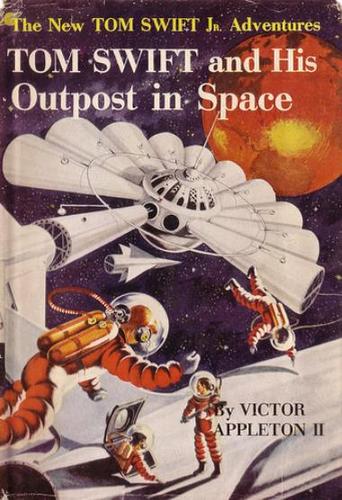
Reach for this book when your child is facing a frustrating setback or a failed project and needs a reminder that 'back to the drawing board' is a part of success. This classic adventure follows young inventor Tom Swift Jr. as he attempts to revolutionize space travel with his Space Kite and Cosmic Sailer. While he faces external threats from rivals like the renegade Li Ching, the heart of the story lies in Tom's ability to analyze why his inventions fail and use that data to build something better. Ideal for ages 8 to 12, the story emphasizes the importance of grit and the scientific method. Parents will appreciate the way it frames failure as a stepping stone rather than an end point. It is a fast-paced, high-stakes mystery that celebrates technical curiosity and the bond between friends who tackle big problems together.
Your experience helps other parents find the right book.
Sign in to write a reviewAction sequences involving sabotage and attempts by criminals to capture the protagonists.
Written in 1960; features some stereotypical 'villain' archetypes common to that era.
The book is a secular mid-century adventure. Antagonists are presented with clear moral boundaries (villains vs. heroes). Some outdated 1960s perspectives on international 'renegades' may require light context, but the approach is direct and action-oriented.
A middle-grade student who enjoys LEGOs, coding, or taking things apart to see how they work. It is perfect for the child who feels discouraged by a low grade or a failed experiment and needs to see a hero who wins by thinking his way out of trouble.
The book is safe for cold reading. Parents might want to discuss the 1960s 'Space Race' context to explain the book's specific brand of techno-optimism. A parent might see their child throw a project away in frustration or express that they 'aren't good at' science or math after a single mistake.
Younger readers (8-9) will focus on the 'cool factor' of the inventions and the peril of being lost in space. Older readers (11-12) will better appreciate the trial-and-error process and the persistence required in the engineering cycle.
Unlike many modern sci-fi books that rely on 'magic' technology, Tom Swift stories emphasize the actual process of inventing, repairing, and refining machines.
Tom Swift Jr. is on a mission to make space exploration affordable through his invention, the Space Kite. However, he is plagued by two distinct antagonists: Li Ching, a renegade scientist leading a group of secrets-pirates, and Olin Whaley, an international criminal. After a harrowing test flight where Tom and his friend Bud are nearly lost in space due to a mechanical defect, Tom must use his engineering skills to diagnose the failure and construct the superior Cosmic Sailer while fending off sabotage.
This overview was generated by AI based on the book's content and reviews, and may not capture every nuance.