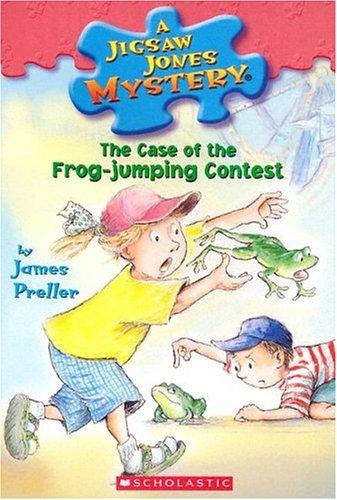
A parent should reach for this book when their early reader is ready for their first chapter book mystery but isn't quite up for complex plots. It's perfect for a child who loves puzzles and enjoys feeling smart. In 'The Case of the Golden Key,' second-grade detective Jigsaw Jones and his partner Mila are on the case to find a teacher's missing key before their friend gets in trouble. The story masterfully introduces concepts of deduction, observation, and teamwork in a low-stakes, familiar school setting. This book is a fantastic way to build reading stamina and critical thinking skills, empowering young readers by letting them solve the very manageable puzzle right alongside the characters.
This book is free of sensitive topics. The central conflict is a very low-stakes mystery about a misplaced object. The approach is secular and realistic within a school environment. The resolution is hopeful, gentle, and reinforces friendships, showing that the 'crime' was just a misunderstanding.
The ideal reader is a 6 to 8-year-old who is just transitioning to chapter books. This child enjoys puzzles, riddles, and games like 'I Spy.' They are developing their logical thinking skills and would feel a great sense of accomplishment from following the clues and solving a mystery that is perfectly tailored to their cognitive abilities.
Your experience helps other parents find the right book.
Sign in to write a reviewNo parent prep is needed. The book is self-contained, and its school setting and simple mystery are immediately accessible to young readers. It can be read cold without any context. A parent has noticed their child showing a new interest in cause and effect, asking 'why?' constantly, or trying to figure out how things work. The child might be ready for a book with more text than a picture book but still needs the support of short chapters and illustrations. The parent is looking for a gentle, engaging series to hook a new independent reader.
A 6-year-old will likely enjoy the adventure and the fun of being a 'detective,' focusing on the characters' actions and the satisfaction of finding the key. An 8 or 9-year-old will engage more deeply with the logical process. They will likely try to solve the secret code themselves and appreciate the cleverness of the clues and how Jigsaw puts them together.
Compared to other children's mystery series, Jigsaw Jones is uniquely positioned for the very earliest chapter book readers. While Encyclopedia Brown requires more abstract reasoning and Nate the Great has slightly more complex vocabulary, 'The Case of the Golden Key' features larger font, simpler sentence structures, and a plot that is entirely contained and solvable within a young child's direct experience. It is the perfect 'my first detective novel.'
Jigsaw Jones, a second-grade private eye, is hired by his friend Ms. Gleason to find her missing golden classroom key. With his business partner, Mila, Jigsaw follows a trail of simple clues, including a secret code left on the chalkboard. They interview classmates, gather evidence, and use logical deduction to solve the case. The resolution reveals that the key was not stolen but borrowed by another classmate in a simple, well-intentioned misunderstanding. The book emphasizes the process of investigation and the satisfaction of solving a puzzle.
This overview was generated by AI based on the book's content and reviews, and may not capture every nuance.